


[Note from Pete and Elias: We’re always happy to get feedback on our Lost Prophets, especially thoughtful reflections like this one from friend-of-the-pod Alfredo Matthew III. Please join Alfredo in sending us your thoughts — and we may share to the Lost Prophets community! To do so, email LostProphetsPodcast@gmail.com or leave a voicemail at our new voicemail line: 703-662-3046.]
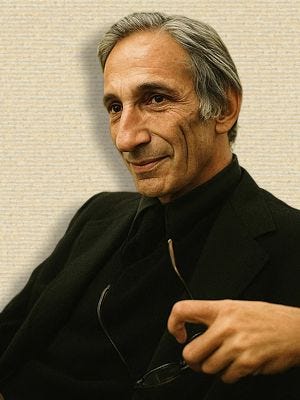
Part I – Encountering Illich: Personal Journey & Prophetic Voices
“Neither new attitudes of teachers toward their pupils, nor the proliferation of educational hardware or software in the classroom, nor even the attempt to expand the teacher’s responsibility until it engulfs students’ lifetimes will deliver universal education. The current search for new educational funnels must be reversed into the search for their institutional inverse: educational webs, which heighten the opportunity for each person to transform each moment of living into one of learning, sharing, and caring.” —Ivan Illich, Deschooling Society
I first encountered Ivan Illich when I was young, reading beyond my comprehension but not beyond my intuition. His writing cut against the triumphalism of modern Western institutions. He spoke less like a social theorist than a prophet—naming the ways systems designed to serve human flourishing could slowly invert and dominate it. I return to Illich now with decades of experience inside the institutions he critiqued—schools, bureaucracies, programs that both empower and suffocate. Time has not dulled his relevance. If anything, technological acceleration and institutional decay have made his questions sharper.
What drew me most to Illich was his image of “educational webs.” Not funnels, not pipelines, but networks of human connection—relationships that allow each moment of life to become one of learning, sharing, and caring. The metaphor is simple, but radical. It shifts the locus of education from institutions to relationships, from credentialing to loving encounter.
Illich stands alongside figures such as Paulo Freire and Myles Horton, who gave language to liberation in an age of industrial expansion. Together they formed a mid-20th-century chorus warning that progress, if detached from humility and community, would erode the very humanity it claimed to advance. Illich’s words are not artifacts stuck in the past. They remain a living invitation to reimagine how we learn, how we build, and how we live together.
Part II – Antichrist, Institutions, and Integrity
In his Lost Prophets interview, David Cayley describes Illich’s critique as striking at the sacred cows of modern life—education, medicine, transportation, development—institutions that had become, in Illich’s phrase, “terminally counter-productive.” They began as expressions of care. Over time, they hardened into systems that displaced human agency.
Illich was not a reactionary or a Luddite. He was a radical Catholic and a cultural critic who understood how institutions born of love could become idols. Cayley names Illich’s most unsettling claim: when institutions claim to embody love and compassion, yet become compulsory and self-perpetuating, they begin to resemble the Antichrist. Not because they are evil in origin, but because they substitute mechanisms for mercy and administration for relationships.
The language is jarring. Yet it cuts across contemporary ideological lines. On the right, figures such as Peter Thiel warn of stagnation and cast climate activism or government regulation as civilizational threats to technological progress. On the left, professionalized social change leaders speak the language of justice while presiding over multimillion-dollar nonprofits that can become as self-protective as the corporations they critique. Both camps risk externalizing the danger. The enemy is always “out there”: the state, the market, the other tribe.
Illich’s warning runs deeper. The Antichrist is not merely an opposing ideology or political adversary. It is the moment when power disguises itself as salvation.
It is the temptation—present in founders, executives, activists, technologists—to believe that one’s own system, scaled sufficiently, can redeem the world. The most dangerous person in the world is not the declared villain, but the one who mistakes a half-truth for the whole, and with reckless certainty lives that lie as if it were truth itself.
This conviction shaped Illich’s most radical act: shutting down CIDOC, the Center for Intercultural Documentation he founded in Cuernavaca. CIDOC had become a seedbed for liberation theology and a magnet for thinkers from around the world. It was influential, well-funded, and growing. Most founders would have scaled and institutionalized. Illich shut it down. What looked like madness was, for him, integrity. He sensed the gravitational pull toward bureaucracy, the subtle shift from conversation to program, from encounter to institution. What looked like madness, even self-sabotage, was for him an act of integrity.
Real prophets are dangerous. They refuse co-optation. They stand outside the system’s logic, even at the cost of their own survival. Unlike today’s professionalized social change sector, Illich lived closer to the prophetic edge.
But history shifted in the 1970s. Counterculture was absorbed into capitalism. Steve Jobs traveled to India, lived in a commune, returned to California, and transformed that ethos into a trillion-dollar company. “Think Different” became the slogan of the new establishment. The outsider became the operator.
Illich was different. He was not an operator. He was a founder. A prophet. He would rather dismantle what he built than watch it calcify into the very structure he opposed.
Part III – Purity, Paradox, and the Invitation
Illich’s critique leaves us with a tension: the purity of the prophet versus the compromised reality of life inside institutions. It is one thing to stand outside and critique, another to live within the mess of the world. Institutions are flawed because we are flawed—our insecurities, our hunger for power, our tendency toward hierarchy are etched into them.
It is tempting to imagine a society of outsiders, a community of prophets. But there is no such thing. In my faith, Christ is the only sinless figure. The rest of us must live in history, choosing again and again between pride and humility, domination and service.
This is where I part ways with those who critique from a distance. We cannot escape the world. We all have to get our hands dirty. There is no life outside of time, no humanity outside of society.
Thich Nhat Hanh once described ideology as blindness; systems of thought that calcify into prisons. The Buddha taught that the way forward is direct experience: breathing, meditating, walking. Yet even Buddhism became an ideology. Even the sutras hardened into doctrine.
The same is true of Deschooling Society. Illich’s vision of webs of learning, mutual aid, and direct encounters is compelling. But once turned into dogma, even deschooling risks becoming another ideology. The scale of the modern world complicates the question. Eight billion people. Hundreds of trillions of dollars circulating through capital markets. The challenge is not whether small communities can flourish; they can. The question is how freedom and dignity endure at scale.
Today, some of Illich’s arguments are weaponized by free-market advocates. Compulsory schooling is being deconstructed through vouchers and “school choice” rooted in Milton Friedman’s economics. Microschools and learning pods proliferate, while public schools fragment further. Public education fails in many ways, yet for all its flaws, it remains one of our last civic commons. To abandon it entirely is to concede another public square to privatization and tribalism. The task is not escape, but reinvention.
This is Illich’s paradox. His critique cut to the roots of the Church, the State, the School, the Hospital. But his free associations never hardened into an alternative system. He was not a policymaker, nor did he try to be. Critiques without solutions leave the door open for domination to persist—first by the state, and then, in its absence, by the private market. Neither serves human freedom, nor aligns with our highest purpose and deepest love: to be creators in the image of God. By refusing to engage capital markets, Illich and other prophets left the field open for neoliberals to seize the global economy. Power does not disappear; it relocates. And yet this was his role: not to build institutions, but to bear witness to their corruption.
Which brings me back to his gift: the ability to hold paradoxes, and to trust in God. We cannot live from fixed truths or rigid ideologies. We must stay open to relationships, open to surprise, open to the Spirit’s whisper in the midst of confusion.
Universal education, for Illich, was never a destination. It was an invitation to transform each moment of life into one of learning, sharing, and caring; to see and be seen.
That invitation is still with us. It asks us not to withdraw from institutions nor to worship them, but to inhabit them with humility and courage. It is intergenerational. It is fragile and demanding. But it is also simple: love God, love your neighbor, and keep making the world anew, even in the ruins of our institutions.
Alfredo Mathew III is an educator, entrepreneur, and systems builder with more than 25 years of experience at the intersection of teaching, entrepreneurship, and community wealth building. His work has taken him from classrooms in the South Bronx and Oakland to launching hundreds of Black- and Brown-owned businesses and designing the first Shared Prosperity Community Corporation. Across each chapter, he has pursued a single question: how to build an economy where work leads to ownership, dignity, and agency. Follow his writing at his Shared Prosperity substack and personal substack.
If you would like to join Alfredo in submitting a reflection to the Lost Prophets community, please email LostProphetsPodcast@gmail.com. And if you would like to record an audio message or question we might play on the show, call our new voicemail line at 703-662-3046.

I am a relative newcomer to Ivan Illich but I find his writings, conversations, and life all of a piece and it is a very compelling way of life. Thank you so much for your piece which really helped me understand him more deeply.
Thanks for creating a venue to share such reflections, and thanks to Alfredo for the reflection.
This one particularly resonates strongly with me. My wife is a public school teacher at HB Woodlawn and is actively engaged in the process of trying to revitalize and resurrect the public school system by giving it a does of vitality. HB is a counter-cultural public school that started in 1978. It has slowly lost some of its counter-cultural roots and is resembling more of a main-stream school. She is trying to get it to be reanchored to its roots and revitalize it with human spirit primarily by injecting self-directed learning and empowering student agency. She is also anchoring it in its others pillars. It's impressive to see her work slowly and methodically to show care and compassion for both the institution and the people the institution serves.