



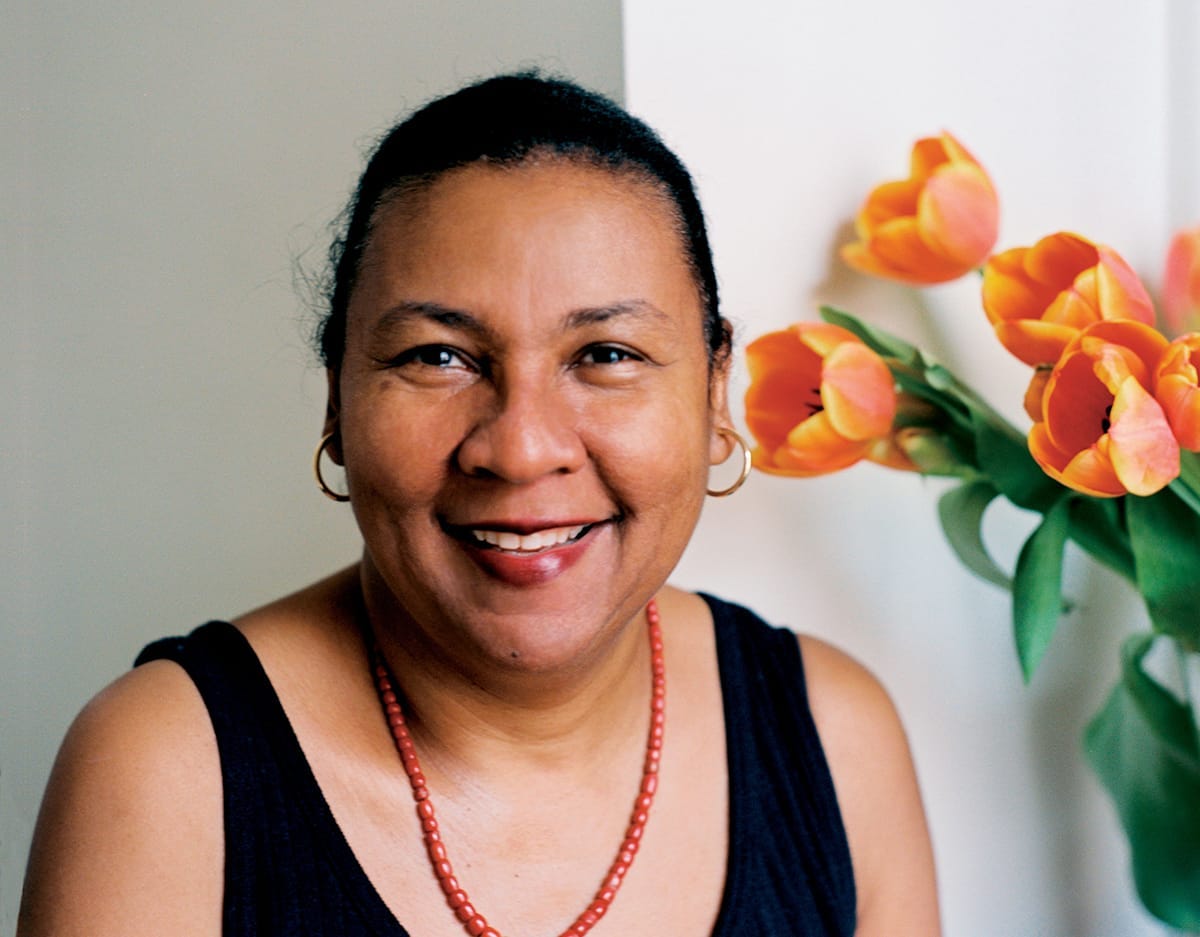
“If I were really asked to define myself, I wouldn’t start with race; I wouldn’t start with blackness; I wouldn’t start with gender; I wouldn’t start with feminism. I would start with stripping down to what fundamentally informs my life which is that I’m a seeker on the path. I think of feminism, and I think of anti-racist struggles as part of it. But where I stand spiritually is, steadfastly, on a path about love.”
Gloria Jean Watkins, born in Hopkinsville, Kentucky in 1952, once said she chose her public name—bell hooks—as a way of honoring a woman who had gone before her: her maternal great-grandmother, who was known for her sharp tongue. She also wanted to step away from her parents’ choice of Gloria Jean, which she thought “a southern belle’s name.” Her preference for using the lower case may derive from the 1960s fashion of making your own ego secondary to the cause.
The author of over 40 books of essays, poetry, children’s literature, and scholarly articles, hooks’ subjects were love, race, class, gender, art, mass media, sexuality, and feminism.
Some key takeaways from our conversation:
Born a half century after civil rights pioneer Ella Baker, her feminism picks up the struggle for Black women to be heard.
She saw the creeping nihilism damaging much of Black life (and American life generally) as stemming from her four-headed ideological enemy: "imperialist white supremacist capitalist patriarchy"
Her intersectionality is about the interconnectedness of issues, similar to the way King realized at one point that the Vietnam War was not a separate issue from civil rights.
She liked to say her goal was not to become an elite intellectual but “to produce theory people could use.”
Her small town Kentucky origins strongly shaped her later life as she explored both her unhappiness as a child and the warmth of her agrarian community. She also developed a warm friendship with fellow Kentuckian Wendell Berry.
She identified with (and embodied) Cornel West’s idea of an “organic intellectual” who never forgot her roots.
She used the reach of popular culture—especially film—as a way of connecting more directly with her students.
Her spirituality, which began in her Stanford years in an encounter with Gary Snyder’s Buddhism, grew as she aged and became a driving passion of her life.
Timestamps:
[00:10:00] Spiritual Influences: Discussion of how the dialogues between Thich Nhat Hanh and Daniel Berrigan helped hooks unite spiritual quest with radical activism.
[00:14:00] Ain’t I a Woman?: Background on hooks’ 1982 foundational third-wave feminist text that addressed the unique oppression of black women.
[00:31:30] Intellectual Discipline: A look at hooks’ daily routine, which included waking early to read one non-fiction book a day and limiting internet and cell phone use.
[00:42:30] “Homeplace” as Resistance: Analysis of hooks’ argument that the private home serves as a radical site of resistance and a sanctuary from public oppression.
[00:51:30] The Love Trilogy: Exploration of hooks’ best-selling books on love, where she defines love as a “verb” and an active practice within community.
[01:05:30] Connection to Wendell Berry: Discussion of hooks’ 2009 book Belonging and her shared vision with Berry regarding land, rural life, and Kentucky roots.
[01:20:30] Interview with Nadra Nittle: A conversation with the author of bell hooks’ Spiritual Vision.
Recommended:
Ain’t I A Woman (1982)—her breakout first book, looking at the condition of Black women from the time of slavery through 1980
Breaking Bread: Insurgent Black Intellectual Life (1991)—conversations with her friend Cornel West
Teaching to Transgress (1994)—strongly influenced by Paulo Freire
Outlaw Culture (1994)—essays on culture, including pop star Madonna, the Clarence Thomas/Anita Hill controversy, and Spike Lee’s Malcolm X
Bone Black (1996)—hooks’ luminous memoir of her girlhood in rural Kentucky
All About Love: New Visions (1999)—the first of three books on love
Homegrown: Engaged Cultural Criticism (2006)—conversations with the Latina artist and scholar Amalia Mesa-Bains
Belonging: A Culture of Place (2008)—reflections on her rediscovery of her native region, including an interview with her friend Wendell Berry
bell hooks’ Spiritual Vision: Buddhist, Christian, and Feminist by Nadra Nittle (2023)


