



[ First, some exciting podcast news. We now have a LOST PROPHETS voicemail line. If you call the number (703) 662-3046, you can leave us a short question, a reflection, an idea — and we may play it on the show!]
Do not depend on the hope of results. You may have to face the fact that your work will be apparently worthless and even achieve no result at all, if not perhaps results opposite to what you expect. As you get used to this idea, you start more and more to concentrate not on the results, but on the value, the rightness, the truth of the work itself. You gradually struggle less and less for an idea and more and more for specific people. In the end, it is the reality of personal relationship that saves everything.
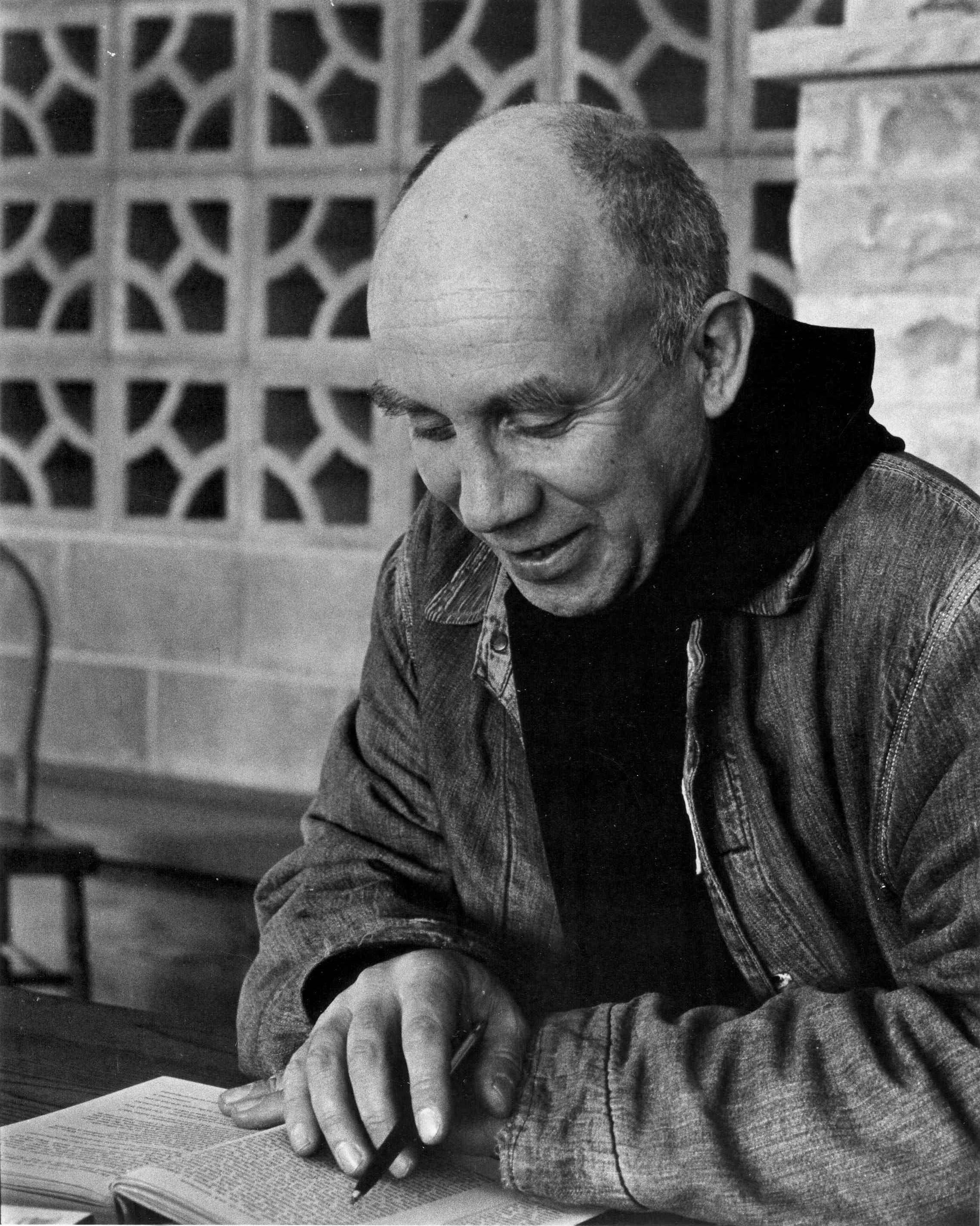
These sentences are from a three-page personal letter written in 1966 by Thomas Merton to peace activist and Catholic Worker Jim Forest. Merton is responding to Forest’s despair at the mounting toll of deaths in the Vietnam War.
Near the end of the letter, Merton writes, “The real hope, then, is not in something we think we can do, but in God who is making something good out of it in some way we cannot see. If we can do His will, we will be helping in the process. But we will not necessarily know all about it beforehand…”
Thomas Merton (1915-1968), the Trappist monk, theologian, mystic poet and social activist, “teaches us how to live a life of conscience in difficult times,” as critic Robert Inchausti once put it. As popular with readers today as in his own lifetime, Merton is considered by many the most important Catholic writer in English of the 20th century.
Merton also possessed a sparkling intellect which combined the rigor of the New York intellectuals with the probity of the Desert Fathers. He speaks directly to our solitude through a rigorous examination of his own.
He was a professed member of the Abbey of Our Lady of Gethsemani, near Bardstown, Kentucky, living there from 1941 until his death. Somehow he managed to write more than 50 books in a period of 27 years, along with many essays and reviews.
Merton was a keen proponent of interfaith understanding, both within the tradition of Christianity and also between Eastern and Western faiths.
Some key takeaways from our conversation:
Born in France, orphaned at 15, and educated in England, Merton was a quintessential “outsider” in American mid-century culture and the harbinger of a still-to-be-realized contemplative counterculture.
We must grasp the distinction between our true and false selves, between the pseudo-identities we possess as conditioned members of society and the person we truly are, known only by God. (A key theme of his New Seeds of Contemplation.)
In 1948, Merton published the book for which he is most famous: The Seven Storey Mountain, a memoir of his path to entering Gethsemani monastery at age 26. The book remained at the top of nonfiction bestseller lists for two years and made Merton the most famous monk in the world. Although he expressed misgivings in later years over the book’s zealous tone, it was (and still is) responsible for many conversions to Catholicism, the religious life, and faiths of all kinds.
Connections to others of our Lost Prophets: His interest in what is now called eco-spirituality is seen in his correspondence with Rachel Carson. He was also a close collaborator with and friend to Daniel and Phil Berrigan, although they sometimes differed on the limits of radical witness.
His association with Catholic Workers and his pacifism got Merton silenced for a time in the 1960s. He began privately publishing what came to be known as the Cold War Letters.
His interest in Asian religions began in his teenage reading about Gandhi. He met Zen writer D.T. Suzuki in New York in 1964 which sparked his interest in the ancient Chinese philosopher Chuang Tzu, whose classic sayings he translated in 1965.
He did not seek to convert to Buddhism nor did he wish for a syncretistic blend of world religions—only a deepening of true ecumenism.
Our guest, Nick Scrimenti, is a dialogue facilitator, spiritual director and educator. He studied theology at Georgetown and Harvard Divinity School — and lived and worked at the Bonnevaux Centre for Peace, a lay-monastic retreat center in rural France. He wrote the introduction to the Merton Annual’s publication of a 1976 letter written at Gethsemani by Fr. John Main, who with Merton helped revive the Christian contemplative tradition in the twentieth century.
Timestamps:
[00:03:30] — Pete & Elias on Merton’s place in the “web” of Lost Prophets and his counterculture contemporaries
[00:06:45] — Merton’s origins: born in wartime France, artist parents, orphaned young, perpetual wanderer across Europe and America
[00:17:00] — Columbia University, Mark Van Doren, the Great Books scene, Robert Lax, and the seeds of conversion
[00:37:00] — The conversion arc: Cambridge disgrace, a night on the floor in Rappahannock, the Cuba epiphany, Friendship House vs. Gethsemane, and choosing the Trappists
[00:48:00] — Entering Gethsemane; The Seven Storey Mountain, the monastic counterculture it sparked, and why it became the surprise bestseller of 1948
[01:22:00] — The false self vs. the true self; solitude as new birth; the Fourth & Walnut revelation; monasticism as counterculture
[01:36:00] — Engagement with the world: the peace movement, civil rights, Cold War Letters, correspondence with hundreds of people
[01:59:00] — The final years: a nurse named M, the Asia pilgrimage, Buddhist dialogue, meeting the Dalai Lama, and Merton’s mysterious death
[02:19:00] — Interview with Nick Scrimenti on Merton’s legacy, Fr. John Main, contemplation vs. the attention economy, and monasticism for today
Recommended:
The Seven Storey Mountain (1948)—an autobiography of a mind which has encountered writers like William Blake, Etienne Gilson, and Aldous Huxley amidst world war and cultural upheaval.
Wisdom of the Desert (1960)—Reflections on the lives and spirituality of ancient Christianity’s Desert Fathers of Egypt, Arabia, and Palestine.
New Seeds of Contemplation (1961)—Considered a classic text on Christian practices of meditation and contemplation.
Way of Chuang Tzu (1965)—Merton’s translation and interpretation of this sage of early Taoism.
Conjectures of a Guilty Bystander (1966)—Notes, opinions, experiences, and reflections on political, social, racial and culture topics of all kinds.
Mystics and Zen Masters (1967)—Reflections on early monasticism, Russian Orthodox spirituality, the Shakers, and Zen Buddhism seen as different ways of pursuing The Way.
Zen and the Birds of Appetite (1968)—Essays exploring the relationship between Christianity and Zen.
Asian Journal (1968)—Notes on his travels across Bangkok, India and Ceylon in the last year of his life, including the address he gave only hours before his untimely death.
“Nhat Hanh Is My Brother”—Merton’s short 1966 essay, originally published in Jubilee magazine, declaring his solidarity with the Vietnamese Buddhist monk and making the case for a brotherhood that transcends nationality, religion, and politics.
Raids on the Unspeakable (1966)—A collection of essays, meditations, and prose poems, including “Rain and the Rhinoceros,” Merton’s celebrated reflection on solitude, nature, and resistance to the consuming logic of modern life.
When Prophecy Still Had a Voice: The Letters of Thomas Merton and Robert Lax (2001)—All 346 known letters between Merton and his closest friend, spanning thirty years from Columbia to Bangkok.
The Seven Mountains of Thomas Merton (1984)—Michael Mott’s biography of Merton, drawing on private journals and interviews to tell the full story of his life.
“Thomas Merton: The Monk Who Became a Prophet”—Alan Jacobs’s essay in The New Yorker, written on the 50th anniversary of Merton’s death, tracing his spiritual and artistic development from turbulent youth to contemplative prophet.
Meditation en Masse—an article by Erik Braun on the colonial roots of the mindfulness boom.
From Deus in Adiutorium to Maranatha: Colonialism and Reform in John Main’s Hindu Encounter (2021)—an article by our guest Nick Scrimenti on John Main’s hybrid method of Christian contemplation, drawing on meditation techniques of Swami Satyananda and the “prayer formula” of 4th century Christian theologian John Cassian.
No Man Is an Island — an essay by Nick Scrimenti in Commonweal about the relationship between therapy, spirituality, and asceticism
Fr. Matthew Kelty has a homily on “Desolation Row” in this collection


