




[ Reminder: We now have a LOST PROPHETS voicemail line. If you call the number (703) 662-3046, you can leave us a short question, a reflection, an idea — and we may play it on the show! Also, we always love emails to LostProphetsPodcast@gmail.com.]
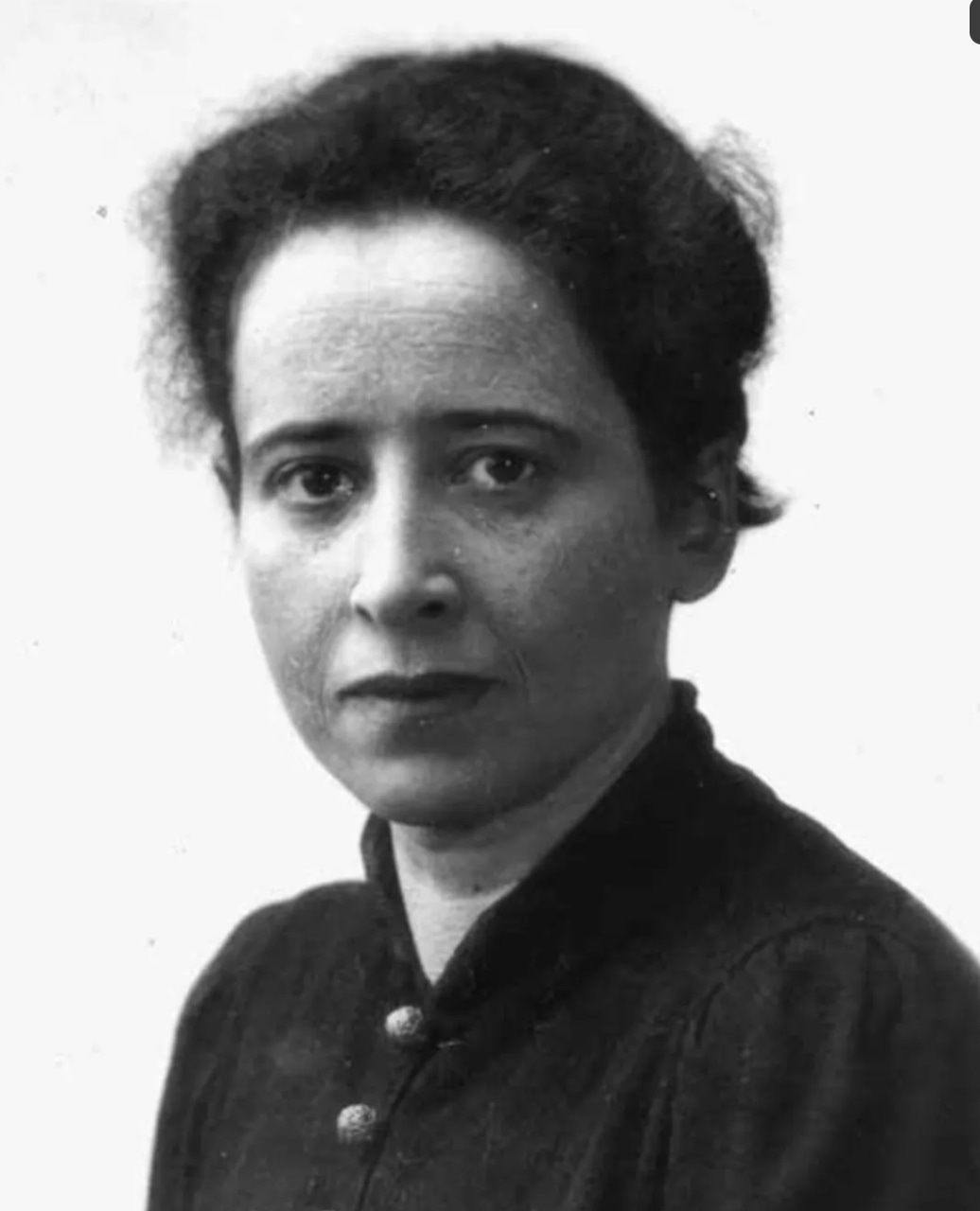
Already a classic text in modern political thought, Hannah Arendt’s Origins of Totalitarianism returned to the bestseller lists in the months following the 2016 election. In the first year of Donald Trump’s presidency, overall sales of the book—originally published in 1951—increased by over 1,000 percent.
Arendt’s stature among academics is a bit ironic: she was a creative and complex thinker who never called herself either a political scientist or a philosopher. For different reasons, she was deeply skeptical of both fields—and yet she is one of the most cited names in the realm of politics and political science today.
Born in 1906 into a Jewish family in Hanover, Arendt became a witness to the emergence of a new kind of regime: totalitarianism, with its mechanisms of domination far beyond those of mere dictatorship or tyranny.
In this first of two episodes on the large legacy of this prophetic thinker, we concentrate on Arendt’s dramatic and tragic years in Europe leading up to her fleeing the Nazis and publishing Origins.
The second episode will take up her life and work as she becomes both an enthusiastic citizen and then a discerning critic of the United States.
Key takeaways from this episode:
Arendt is born in 1906 to a non-observant and highly literate Jewish family in Hanover. She experiences some anti-Semitism in school but learns early on to speak up for herself.
Growing up in the crises around the Great War, Arendt spends much time indoors in her father’s library, reading Homer, Schiller, Goethe, Kant and Jaspers, among other great names.
Her politically active mother takes her to hear Rosa Luxemburg speak at a general strike rally a few months before the murder of the latter and Karl Liebknecht in January 1919.
She audits classes at the University of Berlin for several months in 1922, studying with Romano Guardini.
She arrives at the University of Marburg in 1924, age 18, to study with rising philosopher Martin Heidegger, taking courses with him on Plato and Aristotle. Eventually she begins an affair with her teacher which lasts a little over one year, although they continue to correspond until Heidegger joins the Nazi party in 1933. Their letters resume intermittently after the end of the Second World War.
In 1925, she spends a semester in Freiburg studying with Edmund Husserl before moving to Heidelberg to begin studies with Karl Jaspers, thus having the opportunity to work with three of the 20th century’s most famous names in philosophy.
Under Jaspers, she writes a dissertation on the topic of “Love and St. Augustine,” a shift in her thinking, away from Heidegger’s style of solitary thought focused on the self toward Jaspers’ dialogic and plural approach.
Augustine gives Arendt the language of new beginnings, neighborly love, and love of the world—themes that will remain throughout all her future work.
February 27, 1933: The Reichstag fire and the anti-Semitic repression in its wake convince Arendt to flee Germany for France. Before she and her mother can leave, they are both interrogated for eight days by a young Gestapo officer.
She carries with her the manuscript of a biographical study, Rahel Varnhagen: The Life of a Jewish Woman. Arendt is fascinated by this figure, the first Jewish woman to establish herself as a leading intellectual and political figure in Germany. Varnhagen reveals to Arendt the complex nature of the pariah, a social role that Arendt will both describe and embrace in her work.
In these years, she works for Jewish relief organizations like Youth Aliyah and conducts the library research on antisemitism which gets her arrested in July 1933.
January 16, 1940: Arendt marries Heinrich Blücher in Paris. Four months later, they are both ordered into separate internment camps. After four weeks, Arendt is one of only around 200 people out of 7,000 who manage to escape, next reaching Lourdes in search of her friend Walter Benjamin. Gurs, the rural camp where Arendt was interned, later comes under the jurisdiction of Adolf Eichmann, who sent the entire population of the camp to Auschwitz.
May 22, 1941: After months in Montauban and Lisbon, Arendt and Blücher arrive at Ellis Island with 25 dollars and very little English. Both are stateless refugees. After settling in New York City, she begins writing Origins of Totalitarianism with Blücher as an intellectual interlocutor and sounding board.
Origins of Totalitarianism
An unconventional history of this new phenomenon in three major sections: Antisemitism, Imperialism, Totalitarianism.
She did not believe in any doctrine of eternal hatred for the Jews nor did she believe that traditional Jew-hatred (the old anti-Semitism grounded in religious division) was the same thing as the new phenomenon of ideological antisemitism which she gave a new spelling in order to indicate a difference.
Her broad sense of social history: insightful thumbnail portraits of Benjamin Disraeli, Marcel Proust, Alfred Dreyfus, T.E. Lawrence, and others.
She discusses the decline in 19th century French politics symbolized by the shift from the figure of the citoyen to that of the bourgeois.
1884-1914: The decades of high Western imperialism leading up to the catastrophe of the Great War.
Racism: the necessary ingredient for the bourgeois elite and the mob to come together politically in order to implement imperialistic goals through a self-justifying cover story.
What’s unprecedented in totalitarianism: The state becomes a façade for a world-historical movement in which everything is possible. Two key elements: the instrumentalization of terror and the construction of concentration camps.
These movements offered the masses a chance to escape from reality and the condition of metaphysical homelessness.
A lying world of consistency is created (a “virtual reality” of sorts) — the leader says: I see all the patterns and we can explain everything that happens in terms of the great conspiracy. Much like a cult leader, he then conducts his followers into a counter-conspiracy based in a contempt for the blindness of the outsiders. Actual reality thus becomes a threat to this new counter-reality and state violence must be used to compel events to conform to it.
“What the mob wanted, even at the price of destruction, was access to history.”
Describing the final victory of a totalitarian regime: “The night has fallen on the future, when no witnesses are left—only organized oblivion. Among family and friends, grief and remembrance are forbidden.”
Origins was sometimes seen as a “Cold War book” but she was never an “anti-Communist” and criticized this ideology and its offspring McCarthyism.
“There are no dangerous thoughts: thinking itself is dangerous,” she once stated. She meant: it is dangerous especially to our ideologies.
Recommended:
Hannah Arendt, Love and St. Augustine
Hannah Arendt, Rahel Varnhagen
Hannah Arendt, We Refugees
Hannah Arendt, Origins of Totalitarianism


