



[Reminder: We now have a LOST PROPHETS voicemail line. If you call the number (703) 662-3046, you can leave us a short question, a reflection, an idea — and we may play it on the show! Also, we always love emails to LostProphetsPodcast@gmail.com.]
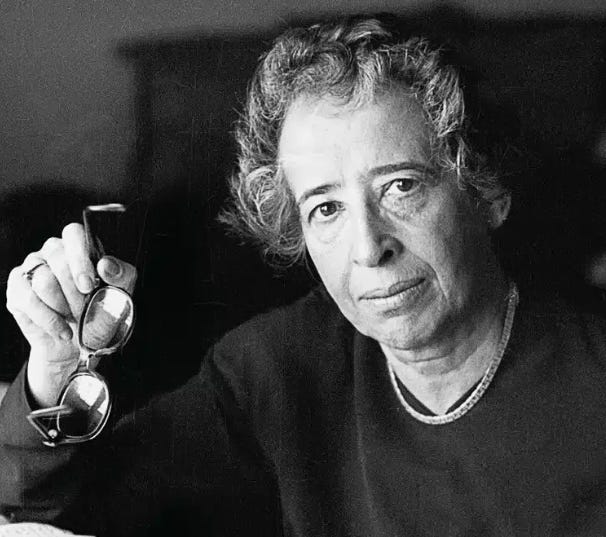
The years between 1941 and 1975—from her arrival with her husband at Ellis Island to her death in New York—comprised the American half of Hannah Arendt’s life.
It resembles another life in two parts, that of our earlier subject, Rabbi A.J. Heschel, also a story of rescue and finding a new role in the world as a wise survivor with stories to tell.
Thinking, Arendt always argued, must come not out of abstractions but out of experience. And while her writing was never merely a journalistic response to the day’s events, the McCarthy period, the Civil Rights movement, and the Vietnam War all affected her understanding of this new country.
We are joined later in the episode by Ned O’Gorman, professor of rhetoric and public culture at the University of Illinois and author of Politics for Everybody: Reading Hannah Arendt in Uncertain Times.
Key takeaways:
Upon the great success of her Origins of Totalitarianism (1951), the book that established her reputation as a public intellectual, Arendt felt the book lacked a conceptual analysis of Bolshevism and the legacy of Marxism—especially her sense of Marx’s unbalanced valuation of work and hostility to politics. Ironically, she began teaching and lecturing on Marx in 1953, amidst McCarthyism, a time of heightened “Red-baiting” in the country.
In 1957, as she was finishing the manuscript of the new book which she wanted to entitle “Amor Mundi” [Latin for “love of the world”], the U.S.S.R. successfully launched the Sputnik satellite. This feat was greeted by some observers as heralding a liberation from the human condition of being earthbound, a notion that Arendt found frankly perverse.
When published, the book undertook to address both this earth alienation as well as modern society’s alienation from true politics through a brilliant exploration of the activities of labor, work, and action. The new title became The Human Condition, and in its analysis of the modern fate of human freedom, it has proved to be her masterpiece.
Arendt next aimed to give her readers “experience in how to think.” The essays collected in her Between Past and Future (1961) “do not contain prescriptions on what to think or which truths to hold.” Instead, they explore our unprecedented in-between situation of modernity which she famously described as “the break in tradition.”
Her method in these exercises is to plumb the depths of meaning in common words whose definitions we thought we knew. As she turns her enormous reading and intellectual power on terms like freedom, education, authority, tradition, history, and politics, whole constellations of new meaning open up for us.
In 1960, learning that Mossad agents had kidnapped the Nazi official Adolf Eichmann in order to bring him to Jerusalem for trial, she wrote to the editor of the New Yorker asking for the assignment of covering this historic event. The result was her only book of reportage, Eichmann in Jerusalem: A Report on the Banality of Evil (1963). Some consider it the most controversial book of the twentieth century.
Her On Revolution (1963) is a comparative study of the French and American revolutions, a topic that she noted was “embarrassingly topical” in the twentieth century: the Cuban Revolution in 1959, the Hungarian Revolution in 1956, the military coups in Vietnam, South Korea, and Greece, to name just a few. Arendt saw in the American Revolution a chance for a more democratic form of government rooted in local politics, a “lost treasure” which the rise of political parties had made almost irrecoverable. And with that diminishing of citizen engagement, we lost the “spirit of revolution” and all joy in public life.
Men in Dark Times (1968), a collection of reflective biographical sketches of twentieth-century figures, is perhaps her most accessible book. The portraits of Walter Benjamin, Karl Jaspers, Bertolt Brecht, Rosa Luxemburg, Randall Jarrell, Waldemar Gurian, Hermann Broch, Isak Dinesen, and Pope John XXIII touch on many of Arendt’s key themes: plurality, poetry, durability, judgment, storytelling, and friendship. “Even in the darkest of times,” she wrote, “we have the right to expect some illumination.”
The final years of Arendt’s life were dedicated to The Life of the Mind (1978), which she intended as a three-part work: Thinking, Willing, and Judging. The book’s origins lie in a question which came out of her experience attending the Eichmann trial: Can thinking condition us against evil-doing? If it can, she reasoned, then everyone must be capable of thinking: it cannot be relegated to the “professional thinkers,” the privileged few.
In this somewhat daunting book, perhaps her most philosophical, Arendt sets aside the traditional dichotomy between the vita activa and the vita contemplativa in order to show how thinking is an activity in itself.
On the night of December 4, 1975, after dinner with friends, Arendt suffered a heart attack. Her memorial service was held at Riverside Memorial Chapel on December 8 with 300 mourners in attendance. She is buried next to her husband, Heinrich Blücher, in the Bard College cemetery at Annandale-on-Hudson, New York.
Readings mentioned:
Hannah Arendt, The Human Condition (1958)
Hannah Arendt, On Revolution (1963)
Hannah Arendt, Eichmann in Jerusalem: A Report on the Banality of Evil (1963)
Hannah Arendt, Between Past and Future (1961)
Hannah Arendt, Men in Dark Times (1968)
Hannah Arendt, The Life of the Mind (1978)
Hannah Arendt, Crises of the Republic (1972), which collects “Lying in Politics,” “Civil Disobedience,” “On Violence,” and “Thoughts on Politics and Revolution”
Love and Saint Augustine, Arendt’s 1929 dissertation on Augustine
“Reflections on Little Rock” (Dissent, 1959)
“Home to Roost: A Bicentennial Address” (New York Review of Books, 1975)
Ned O’Gorman, Politics for Everybody: Reading Hannah Arendt in Uncertain Times (2020)
Elisabeth Young-Bruehl, Hannah Arendt: For Love of the World (1982, 2004)—both a personal and an intellectual biography, this is the most comprehensive single treatment of her life to date.
Samantha Rose Hill, Hannah Arendt (Critical Lives, 2021)—a concise treatment of Arendt by a younger scholar who draws on archival research for numerous wonderful insights into Arendt.
Lyndsey Stonebridge, We Are Free to Change the World: Hannah Arendt’s Lessons in Love and Disobedience (2024)—yet a third biographical treatment but with an eye on the implications of Arendt’s ideas for current topics like the international refugee crisis, the resurgence of authoritarian regimes, post-truth politics, and political violence. A brilliant writer and thinker, Stonebridge is arguably the closest figure we have to a modern-day Arendt.
Samantha Rose Hill, “When Hope Is a Hindrance” (Aeon)
John Ganz, “The Book of Liberal Maladies: On Samuel Moyn’s Cold War Liberalism” (Unpopular Front)
John Quincy Adams, “Harvard Oration” (1787)
Ivan Illich, Tools for Conviviality (1973)


